German Kochschinken is a classic cooked ham you can’t buy in most American grocery stores. It’s mild, pork-forward, sliceable, and built on control rather than smoke or sugar. In an era of expensive meat and aggressively processed deli products, Kochschinken is worth reviving—not as nostalgia, but as a practical, science-backed DIY project.
This guide walks through how to make authentic German Kochschinken at home using modern tools like brine injection and sous vide cooking, while explaining why each step works. Traditionally made from pork leg, this version uses economical pork shoulder without sacrificing texture or safety.
What Is Kochschinken?
Kochschinken literally means “cooked ham.” In Germany, it refers to whole-muscle pork that is cured with nitrite, gently cooked, chilled, and sliced. It is not heavily smoked, not sweet, and not emulsified. The result is ham that tastes like pork, not additives.
Historically, Kochschinken developed as a preservation method. Pigs were butchered once a year, and curing plus cooking allowed meat to last through winter into spring. Before refrigeration, this process was about survival. Today, it’s about control.
Why You Don’t See Kochschinken in the US
American “ham” is often:
- Pumped with excess water
- Sweetened aggressively
- Mechanically reformed
- Stabilized with long ingredient lists
Kochschinken is the opposite: whole muscle, minimal ingredients, and transparent technique. It doesn’t scale well for industrial production, which is precisely why it’s better made at home.
The Science First: Why Nitrite Is Not Optional
For cooked ham, nitrite curing salt is mandatory for safety. Plain salt alone is only safe in dry-cured products where water activity drops quickly. Kochschinken stays moist and is cooked at relatively low temperatures—conditions where Clostridium botulinum can thrive without nitrite.
Nitrite also:
- Stabilizes the pink color
- Contributes to cured flavor
- Protects during low-oxygen cooking (like sous vide)
This recipe uses Nitritpökelsalz, the standard German curing salt.
Three Ways to Cure Ham (And Why We Inject)
There are three legitimate curing methods:
- Dry Cure – Traditional, slow, weeks long
- Wet Brine – Faster, but still diffusion-limited
- Injected Brine – Fast, precise, and efficient
Injection distributes salt, nitrite, and flavor inside the meat immediately, cutting curing time from weeks to days. Purists may object. Physics does not.
Why Sous Vide Beats Boiling
Traditionally, Kochschinken was simply boiled. It worked—but temperature control was crude. Sous vide allows us to:
- Set proteins without squeezing out moisture
- Avoid gray rings and dry texture
- Cook evenly edge-to-center
A basic immersion circulator (often available used for under $40) replaces guesswork with precision.
ATTENTION:
The curing salt used is German concentration of 0.5% nitrates. To follow this recipe, mix 12 parts plain salt (non-iodized) with 1 part Praque Powder #1 by weight!
Storage
- Vacuum sealed, refrigerated: up to 2 weeks
- Frozen: several months with minimal texture loss
Why This Is Worth Doing
- Cheaper than quality deli ham
- Fewer ingredients, full control
- Better texture and flavor
- Teaches transferable curing skills
This is old-world food made better with modern tools. Same goal. Better precision.
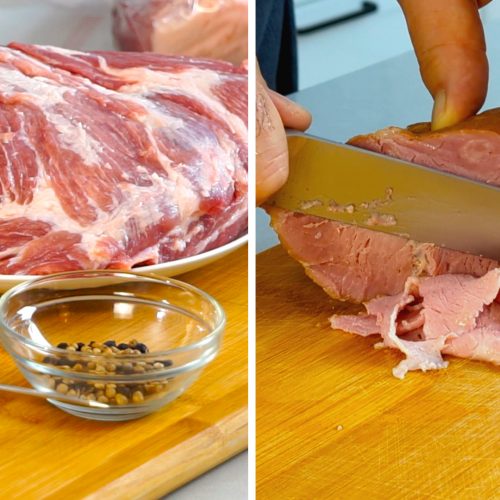
German Kochschinken (Cooked Cured Ham)
Ingredients
- 1.5 kg 53 oz lean pork (leg, shoulder, or loin)
- 1 L water
- 20 g 0.7 oz sugar
- 100 g 3.5 oz nitrite curing salt (Nitritpökelsalz)
- 5 g juniper berries
- 2 g caraway
- 2 g garlic granules
- 2 g black pepper
- 1.5 g coriander
- 2 bay leaves
Instructions
- Boil water with all brine ingredients. Turn off heat and steep until cold. Strain.
- Trim pork clean of cartilage and glands.
- Inject 20–30% of the meat’s weight in brine, spacing injections about 1 inch apart.
- Vacuum seal with an additional 10% brine. Refrigerate 1–3 days, turning occasionally.
- Rinse meat under cold water. Optionally hot smoke for 30–60 minutes.
- Vacuum seal and sous vide at 72°C / 161°F until core reaches 67°C / 153°F (about 3 hours).
- Chill in refrigerator for 24 hours before slicing.
You may also like this

Tafelspitz – How Austria Fixed Lean Beef